You have endometritis. This is an infection of the inside lining of the uterus. There are many possible causes. It may occur after a procedure on your uterus, such as a biopsy or placement of an IUD. It may be caused by a vaginal infection that spread. It may also be caused by a sexually transmitted infection (STI). Testing will be done to look for the cause of the infection so the best treatment can be given. It's not always possible to find the exact cause.
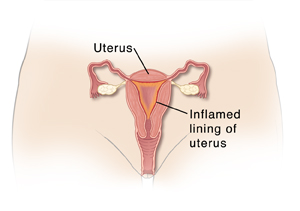
Symptoms of endometritis include:
-
Fever
-
Feeling ill
-
Pain in the lower belly
-
Swelling of the belly
-
Bleeding from the vagina that’s not during your normal period
-
Bad-smelling fluid from the vagina
-
Pain when peeing
-
Pain during sex
In some cases, an infection called pelvic inflammatory disease (PID) also forms. This involves the ovaries and fallopian tubes. If not treated, PID may lead to infertility. This means you may not be able to get pregnant. It can also lead to full-body infection (sepsis). If you have endometritis, you may need more testing to rule out PID.
How to say it
en-doh-muh-TRY-tuhs
Home care
You will be prescribed antibiotics for the infection. Take these as directed by your healthcare provider. Don’t stop taking the medicine even if you feel better. Take all of the medicine until it's gone. In general, your symptoms should get better within 2 to 3 days of starting the antibiotic. If you don’t get better within 3 days of starting treatment, call your healthcare provider.
General care
Plan to rest at home for a day.
Until you have taken all the medicine and your symptoms are gone:
-
Don’t have sex.
-
Don’t put anything into your vagina, including tampons.
-
Don’t douche. Douching is generally not advised at any time.
-
Don’t take a bath, use a hot tub, or swim. Showering is fine.
Follow-up care
Follow up with your healthcare provider or as advised. If an STI caused the infection, your recent sexual partners must be contacted and treated as well.
Call 911
Call
-
Pain in your chest, arm, or jaw
-
Shortness of breath
When to get medical care
Call your healthcare provider right away if any of these occur:
-
Fever of 100.4°F (38°C) or higher, or as advised by your provider
-
Symptoms get worse or you have new symptoms
-
Upset stomach (nausea) or vomiting
-
You don’t get better within 3 days of starting treatment
Featured in
Online Medical Reviewer: Donna Freeborn PhD CNM FNP
Online Medical Reviewer: Heather Trevino
Online Medical Reviewer: Irina Burd MD PhD
Date Last Reviewed: 09/01/2025
© 2000-2026 The StayWell Company, LLC. All rights reserved. This information is not intended as a substitute for professional medical care. Always follow your healthcare professional's instructions.

Related Articles
Yeast Infection (Candida Vaginal Infection)
A yeast infection is a vaginal infection caused by a type of yeast called Candida.
Vaginal Infection: Bacterial Vaginosis
Both good and bad bacteria are present in a healthy vagina. Bacterial vaginosis (BV) occurs when these bacteria get out of balance.
Pelvic Inflammatory Disease (PID)
Pelvic inflammatory disease is an infection of the female reproductive organs. It is most often caused by gonorrhea or chlamydia. If not treated promptly, it can lead to serious health problems.
Amenorrhea
Amenorrhea means you haven't had your period for more than three cycles. It can be caused by a variety of things including overexercising, being overweight, or due to an ovulation problem.