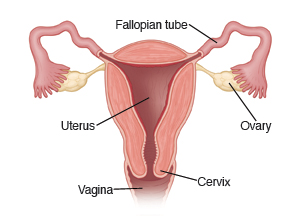
You have a Candida vaginal infection. This is also known as a yeast infection. It's most often caused by a type of yeast (fungus) called Candida. Candida is normally found in the vagina. But if it increases in number, this can lead to infection and cause symptoms.
Symptoms of a yeast infection can include:
-
Clumpy or thin, white discharge, which may look like cottage cheese.
-
Itching or burning.
-
Burning with urination.
Certain factors can make a yeast infection more likely. These can include:
-
Taking certain medicines, such as antibiotics or birth control pills.
-
Pregnancy.
-
Diabetes.
-
A weak immune system.
A yeast infection is most often treated with antifungal medicine. This may be given as a vaginal cream or pills you take by mouth. Treatment may last for about 1 to 7 days. Women with severe or recurrent infections may need longer courses of treatment.
Home care
-
If you’re prescribed medicine, be sure to use it as directed. Finish all of the medicine, even if your symptoms go away. Don’t try to treat yourself using over-the-counter products without talking with your doctor first. They will let you know if this is a good choice for you.
-
Ask your doctor what steps you can take to help reduce your risk of having a yeast infection in the future.
Follow-up care
Follow up with your doctor, or as directed.
When to get medical advice
Contact your doctor right away if any of the following occur:
-
You have a fever of 100.4ºF (38ºC) or higher, or as directed by your doctor.
-
Your symptoms get worse, or they don’t go away within a few days of starting treatment.
-
You have new pain in the lower belly or pelvic region.
-
You have side effects that bother you or a reaction to the cream or pills you’re prescribed.
-
You or any partners you have sex with have new symptoms, such as a rash, joint pain, or sores.
Featured in
Online Medical Reviewer: Fraser, Marianne, MSN, RN
Online Medical Reviewer: Karlin, Ronald, MD
Date Last Reviewed: 07/01/2025
© 2000-2026 The StayWell Company, LLC. All rights reserved. This information is not intended as a substitute for professional medical care. Always follow your healthcare professional's instructions.

Related Articles
Bartholin’s Cyst (No Infection)
When the opening of a Bartholin's gland becomes blocked, the gland may swell and form a cyst. The cyst may vary in size from 1 to 3 cm. It may feel like a firm lump in the labia.
Understanding Straddle Injury
A straddle injury is when an injury occurs to the groin area between the thighs. Learn more about this type of injury, including cause, symptoms, diagnosis, and treatment.
Ovarian Cysts
Ovarian cysts are sacs filled with fluid or tissue that form on or inside the ovaries. There are different types of cysts. Most are harmless and go away on their own.
Pelvic Inflammatory Disease (PID)
Pelvic inflammatory disease or PID is an infection of a woman’s reproductive tract. Scar tissue grows between internal organs leading to ongoing pelvic pain. It can also lead to ectopic pregnancy.