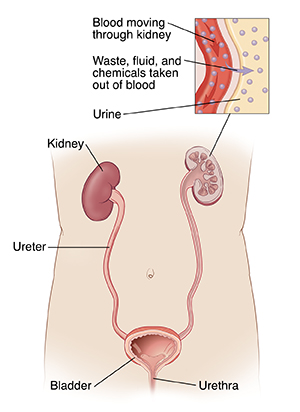
The kidneys’ main job is to clean the blood. They filter wastes and excess fluids from your blood each day. This helps maintain the chemical balance the body needs to stay healthy and alive. One working kidney, even part of a kidney, is enough to do this job. If both kidneys fail, their work must then be done another way.
Kidneys filter the blood
Your 2 kidneys are located just above your waist and below your rib cage toward your back, on either side of the spine. They are bean-shaped and the size of your fist. They filter blood through filtering units called nephrons. There are about 1 million nephrons per kidney. The nephrons:
-
Remove waste and fluid. The kidneys take waste products, such as urea, from the blood. They also remove unneeded fluid.
-
Balance chemicals. The body needs chemicals (such as calcium, sodium, potassium, and phosphorus) to work. Too little or too much of them can make you sick. In the kidneys, chemicals are taken from or added to the blood. This keeps them in the right balance.
The kidneys’ other tasks
In addition to filtering the blood, the kidneys do other tasks. These include:
-
Making erythropoietin to tell the bone marrow to make red blood cells (erythrocytes). These are the cells in the blood that carry oxygen.
-
Helping control blood pressure by making and releasing the enzyme renin.
-
Helping keep bones strong by making a form of vitamin D called calcitriol.
The kidneys may be damaged by a number of conditions. These include:
-
Diabetes
-
High blood pressure
-
Smoking
-
Inherited conditions
-
Immune disorders
-
Injury
-
Certain medicines
Online Medical Reviewer: Marianne Fraser MSN RN
Online Medical Reviewer: Raymond Kent Turley BSN MSN RN
Online Medical Reviewer: Walead Latif MD
Date Last Reviewed: 07/01/2024
© 2000-2026 The StayWell Company, LLC. All rights reserved. This information is not intended as a substitute for professional medical care. Always follow your healthcare professional's instructions.
Related Articles
Discharge Instructions After an Organ Transplant
This sheet includes ways to protect yourself from infection after your transplant. You will continue these precautions until your health care provider tells you to stop. You may need to follow these guidelines for the rest of your life.
Kidney Stones: Your Evaluation
Learn about the tests that can help your health care provider find out if you have a kidney stone, why it formed, and advise treatment.
Monitoring Kidney Health
Your healthcare provider will check the health of your kidneys. That way, treatment can be adjusted if your condition changes. If you have other health problems that affect your kidneys, such as diabetes or high blood pressure, they will be checked also.
Kidney Bruise
Some injuries can bruise your kidney. This may cause blood to appear in your urine. The blood may be in small amounts that you can't see or it might color your urine pink or light red.