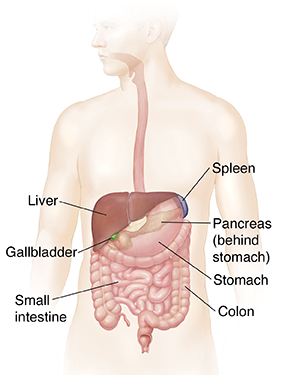
Your belly (abdomen) extends from just below your chest to the top of your pelvis. It contains many vital organs, including your spleen, liver, gallbladder, pancreas, bladder, intestines, and stomach. These organs can be injured by the impact from a car accident or fall. Blunt trauma is an injury from a dull object or force. This type of injury doesn’t break through (pierce) your skin.
When to go to the emergency room (ER)
An abdominal injury can be very serious. For that reason, it's important to call 911 if you've had a blunt injury to your abdomen. You should be taken to the ER by trained medical staff in an ambulance. The effects of blunt trauma often don’t appear right away. So it’s important to see a healthcare provider after a hard blow to the abdomen, even if you feel OK.
What to expect in the ER
Your vital signs (temperature, breathing, blood pressure, and pulse) will be checked. You'll also be examined carefully for injuries. Severe trauma may need surgery right away. Otherwise you'll be watched closely for a time. You may also need to have 1 or more tests to find out the extent of your injuries. These may include:
-
Blood or urine tests. These may be used to determine injuries and how well the organs are working.
-
X-rays. These imaging tests use radiation to take pictures of inside the body. They are mostly used to look for broken bones and problems with your heart and lungs.
-
CT scans. These use a computer and a special type of X-ray machine to give detailed pictures of the inside of your body. This can show problems with bones, as well as with organs, such as your kidneys, spleen, liver, and stomach.
-
Ultrasound. This uses sound waves to make images of the organs, tissues, and other structures in your abdomen. It can also quickly find internal bleeding if it's there.
-
Diagnostic peritoneal lavage. For this test, a needle and plastic tube (catheter) are put through the skin into your abdomen. This is to check fluid from your abdomen for signs of blood (internal bleeding). This procedure is rarely used anymore since ultrasound and other imaging have become so fast and accurate at finding internal bleeding.
Based on the test results, you may be admitted to the hospital. Or you may have further care in the ER.
When to call your healthcare provider
After treatment, call your provider right away if you have any of these:
-
Increased pain or swelling in your abdomen
-
Upset stomach (nausea) or vomiting
-
Fast heartrate (tachycardia)
-
Low blood pressure (hypotension)
Call 911
Call
-
Weakness or fainting
-
Blood in your stool or urine
-
Trouble breathing
Online Medical Reviewer: Eric Perez MD
Online Medical Reviewer: Raymond Kent Turley BSN MSN RN
Online Medical Reviewer: Ronald Karlin MD
Date Last Reviewed: 03/01/2024
© 2000-2026 The StayWell Company, LLC. All rights reserved. This information is not intended as a substitute for professional medical care. Always follow your healthcare professional's instructions.
Related Articles
Rib Bruise
A rib contusion may cause pain, soreness, swelling, and a purplish discoloration. It may also cause a sharp pain when you breathe. Read on to learn about home care to help heal a contusion.
Dehydration
Prompt treatment for even mild dehydration is crucial. At greatest risk for dehydration are infants, children, and older adults. Know when to seek medical help.
Understanding Heat Stress
In hot environments, your body may have trouble keeping its temperature at a safe level. As a result, your body temperature rises to unsafe levels. This is heat stress. Heat stress can develop quickly. It can also be very dangerous to your health.
First Aid: Puncture Wounds
A break in the skin is an open door, inviting dirt and germs to enter your body and cause infection. Follow these instructions to care for a puncture in the skin.