The hip is one of the largest weight-bearing joints in the body. It’s also a common place for a fracture after a fall—especially in older people. Hip fractures are even more likely in people with osteoporosis, a disease that leads to weakened bones.
A healthy hip
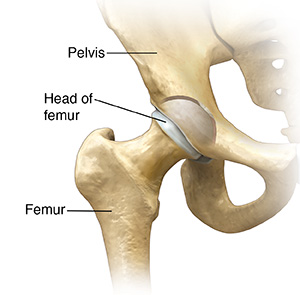
The hip is a ball-and-socket joint where the thighbone (femur) joins the pelvis. When the hip is healthy, you can walk, turn, and move without pain. The head or ball of the femur fits into a socket in the pelvis. The ball and socket are each covered with smooth cartilage. This allows the ball to glide easily in the socket. Blood vessels supply oxygen and nutrients to keep the hip joint healthy.
A fractured hip
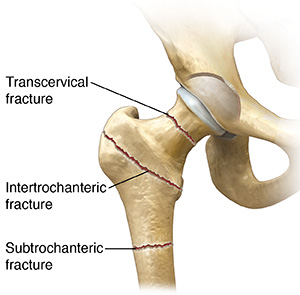
The hip can fracture in many places. Most often, the fracture occurs in the upper part of the femur. In rare cases, you can also have more than one type of fracture at a time:
-
Transcervical fracture. A break across the neck of the femur, just under the ball. This type of fracture can interrupt blood flow to the joint.
-
Intertrochanteric fracture. A break down through the top of the femur.
-
Subtrochanteric fracture. A break across the upper shaft of the femur.
Find the Right Orthopedic & Sports Medicine Specialist for You
BLANCHARD VALLEY HEALTH SYSTEM
Ortho LinkRelated Articles
Joint Dislocation
You have a joint dislocation. This happens when a strong force is applied to the joint, tearing ligaments and forcing the bones out of place. Often no bones are broken. But the nearby nerves and blood vessels can be damaged.
Bursitis
You have bursitis. This is an inflammation of the bursa. These are small, fluid-filled sacs that surround the larger joints of the body. The bursa help the muscles and tendons move smoothly over the joints.
Muscle Spasm
A muscle spasm is a sudden tightening of the muscle you can’t control.
Ankle Fracture
You have an ankle fracture. This means that one or more of the bones that make up the ankle joint are broken.