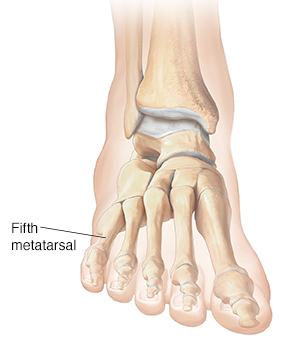
A fifth metatarsal fracture is a type of broken bone in your foot. You have five metatarsals. They are the middle bones in your feet, between your toes and your ankle bones (tarsals). The fifth metatarsal connects your smallest toe to your hindfoot. These bones help with arch support and balance.
How to say it
meh-tah-TAR-suhl
What causes a fifth metatarsal fracture?
A direct blow to the bone is often the cause of a fracture of the fifth metatarsal. That may happen if you drop a heavy object on your foot or land wrong on your foot or ankle. Twisting activities can also break the bone. Pivoting while playing basketball is an example.
Repeatedly placing too much stress on the bone can also cause a fracture of the fifth metatarsal. This is called a stress fracture. People who do physical activities like dancing or running tend to be more prone to stress fractures.
Symptoms of a fifth metatarsal fracture
Sudden pain along the outside of your foot is the main symptom. A stress fracture may develop more slowly. You may feel chronic pain for a period of time. Your foot may also swell up and bruise. You may have trouble walking.
Treatment for a fifth metatarsal fracture
Treatment for this type of fracture depends on where the bone is broken and how severe the break is. Healing can take up to several months. Treatment may include:
-
Cold therapy. Putting ice on the area may reduce swelling and pain, especially in the first few days after injury.
-
Elevation. Propping up the foot so it's above the level of your heart may ease swelling.
-
Prescription or over-the-counter pain medicines. These help reduce pain and swelling. Talk with your doctor before taking any.
-
Immobilization. Devices, such as a splint, cast, or walking boot, can protect the bone and ease pain. They can help keep the bone in place so it heals correctly. You may need to not put any weight on the broken bone for a period of time. Severe fractures usually need a longer limit on weight-bearing activities.
-
Stretching and strengthening exercises. Certain exercises can help you regain flexibility and strength in your foot.
-
Surgery. You usually won't need surgery. But you may need it if the bone is broken into 2 or more pieces and is not aligned (displaced), doesn’t heal correctly, or takes a long time to heal.
Possible complications of a fifth metatarsal fracture
-
The bone doesn’t heal correctly.
-
Acute compartment syndrome: This is when pressure builds up in the muscles of the foot and affects blood flow.
When to contact your doctor
Contact your doctor right away if any of the following occur:
-
Fever of 100.4°F (38°C) or higher, or as directed by your doctor
-
Chills
-
Symptoms that don’t get better, or that get worse
-
Numbness or coldness in your foot
-
Toenails that turn blue or grey in color
-
New symptoms
Author: Semko, Laura
Online Medical Reviewer: Raymond Turley Jr PA-C
Online Medical Reviewer: Stacey Wojcik MBA BSN RN
Online Medical Reviewer: Thomas N Joseph MD
Date Last Reviewed: 05/01/2025
© 2000-2026 The StayWell Company, LLC. All rights reserved. This information is not intended as a substitute for professional medical care. Always follow your healthcare professional's instructions.
Find the Right Orthopedic & Sports Medicine Specialist for You
BLANCHARD VALLEY HEALTH SYSTEM
Ortho LinkRelated Articles
Baker’s Cyst
You have a Baker's cyst. This is a lump in the back of your knee that is caused when extra joint fluid flows into a small sac behind the knee.
Shoulder Dislocation
A dislocated shoulder means the upper arm bone (humerus) has moved out of the shoulder joint. It can cause pain, swelling, numbness and trouble moving the shoulder.
Fluid on the Knee
Fluid on the knee is also called knee effusion. Learn how to care for yourself at home as you heal.
Fractures
A fracture is a partial or complete break in the bone. Read on for details about causes, symptoms, and treatment.