The spine stretches from the base of the skull to the tailbone. It's made up of 33 bones (vertebrae) that help support the body. These bones also protect the spinal cord, the important branch of your nervous system that carries messages from the brain to the body. A broken (fractured) bone in the neck or spine can be very serious. In some cases, it can lead to paralysis or death. Emergency care is vital.
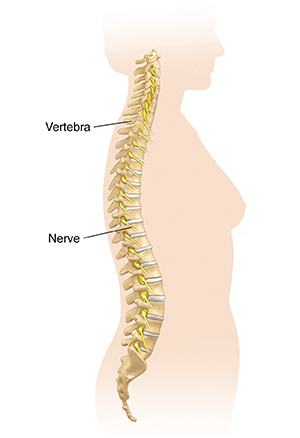
Keep neck and spine injuries still
Don't move a person with a neck or spine injury. The person should lie still and wait for an emergency medical team. It can help for someone to gently hold the person's head to keep it from moving until help arrives.
When to go to the emergency room (ER)
If you come upon a person with a neck or spine injury, call 911 for emergency help right away. Wait for emergency services personnel to arrive and take over. Do not attempt to move someone with a possible spine injury unless their life is in imminent danger. A person with a neck or spinal injury may have symptoms that include:
-
Not being awake or aware (unconscious)
-
Severe back or neck pain
-
Bruising and swelling over the neck or back
-
Tingling or loss of feeling in the hands or feet
-
Loss of bowel or bladder function
-
Loss of feeling and movement below the level of injury
-
Weakness or inability to move arms or legs
What to expect in the ER
Here's what will happen in the ER:
-
The injured person may be placed on a spine board that prevents movement of the spine.
-
X-rays of the neck or spine may be taken.
-
An MRI or CT scan may be done. These provide more detailed images of the structures in the neck and back.
-
Medicine may be given to lessen pain.
Treatment
The goal of treatment is to return the neck or spine to its normal position.
-
A minor neck fracture or simple spine fracture may be treated with a neck brace for 6 to 8 weeks until the bone heals. In this case, it's very important to do what your provider advises for home care and keep all follow-up appointments.
-
Severe or complex fractures often need surgery to ease the pressure on the spinal cord or spinal nerves and to realign the spine with metal rods, screws, and bone grafts. In that case, a spine surgeon (orthopedic surgeon or neurosurgeon) is needed.
Online Medical Reviewer: Anne Fetterman RN BSN
Online Medical Reviewer: Heather M Trevino BSN RNC
Online Medical Reviewer: Joseph Campellone MD
Date Last Reviewed: 09/01/2024
© 2000-2026 The StayWell Company, LLC. All rights reserved. This information is not intended as a substitute for professional medical care. Always follow your healthcare professional's instructions.
Find the Right Orthopedic & Sports Medicine Specialist for You
BLANCHARD VALLEY HEALTH SYSTEM
Ortho LinkRelated Articles
Shoulder Pain With Uncertain Cause
Shoulder pain can have many causes. Pain often comes from the structures that surround the shoulder joint. Pain can also come from cartilage in the joint.
Back Sprain or Strain
Learn how to care for your back sprain or strain at home.
Bone Cyst
A bone cyst is a hole, or cavity, inside your bone that is filled with fluid. Learn how to treat and care for a bone cyst.
Achilles Tendon Injuries
Achilles tendon injuries affect the Achilles tendon, a fibrous band of tissue that links the muscles in your calf to your heel. Learn more about these injuries, including what causes it, who is at risk, what the symptoms are, and how it's diagnosed and treated.