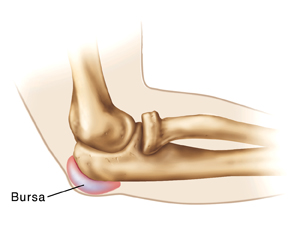
Your elbow contains a small fluid-filled sac called a bursa. The bursa helps the muscles and tendons move smoothly over the bone. It also cushions and protects your elbow. Bursitis is when the bursa is inflamed or swollen. This is most often due to overuse of, or injury to, the elbow. Symptoms include swelling and pain. If the elbow is red and feels warm to the touch, the bursa itself may be infected.
In most cases, elbow bursitis goes away with medicine and self-care at home. It may take several weeks for the bursa to heal and the swelling to go away. In some cases, your health care provider may drain extra fluid from the bursa. Or they may inject medicine directly into the bursa to help relieve symptoms. In severe cases, you may need surgery to remove the bursa. If there is concern that the bursa is infected, your health care provider may prescribe antibiotics to treat the infection.
Home care
Your health care provider may prescribe medicine to help relieve pain and swelling. This may be an over-the-counter pain reliever or prescription pain medicine. Take all medicines as directed. To help treat or prevent infection, your provider may prescribe antibiotics. If these are prescribed, take them as directed until they are gone.
The following are general care guidelines:
-
Apply an ice pack or bag of frozen peas wrapped in a thin towel to your elbow for 15 to 20 minutes at a time. Do this 3 to 4 times a day until pain and swelling improve.
-
Keep your elbow raised above the level of your heart whenever possible. This helps reduce swelling. When sitting or lying down, place your arm on a pillow that rests on your chest or on a pillow at your side.
-
Use an elastic wrap around the elbow joint to compress the area while it is healing. Make the wrap snug but not tight to the point of causing pain.
-
Rest your elbow to give it time to heal. You may need to wear an elbow pad to help protect and limit the movement of your elbow. During and after healing, prevent leaning on your elbows.
Follow-up care
Follow up with your provider as advised. If you've been referred to a specialist, make that appointment promptly.
When to contact your doctor
Contact your health care provider right away if:
-
You have a fever of 100.4°F (38°C) or higher, or as advised by your provider.
-
You have chills.
-
You have increased pain, swelling, warmth, redness, or drainage from the joint.
-
You have trouble moving the elbow joint.
-
You feel numbness or tingling in the hand.
-
You have severe pain or swelling in forearm or hand.
-
There's a loss of pink color and slow return of color after squeezing fingertip or hand.
Online Medical Reviewer: Raymond Kent Turley BSN MSN RN
Online Medical Reviewer: Ronald Karlin MD
Online Medical Reviewer: Thomas N Joseph MD
Date Last Reviewed: 02/01/2025
© 2000-2026 The StayWell Company, LLC. All rights reserved. This information is not intended as a substitute for professional medical care. Always follow your healthcare professional's instructions.
Find the Right Orthopedic & Sports Medicine Specialist for You
BLANCHARD VALLEY HEALTH SYSTEM
Ortho LinkRelated Articles
Groin Strain (Adult)
A groin strain is a stretching or partial tearing of the muscle in the lower abdomen or upper thigh. Here's how to care for yourself at home.
Understanding Ankle Sprain
When ankle ligaments are stretched to the point of pain and injury, it's called an ankle sprain. A sprain can tear the ligaments. These tears can be very small but still cause pain.
Tailbone (Coccyx) Fracture
The tailbone, or coccyx, is at the bottom of your spine. It is possible to break (fracture) this bone when you fall and land in a seated position. This injury takes about 4 weeks to heal. Read on for details on caring for this injury at home.
Shoulder Fracture
You have a break (fracture) of the shoulder. This may be a small crack in the bone. Or it may be a major break with the broken parts pushed out of position.