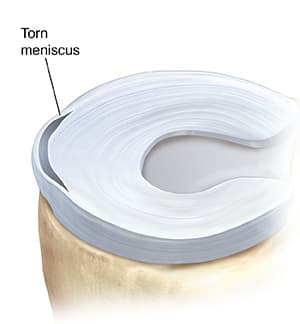
The meniscus is a tough cartilage pad that cushions the inside of the knee joint. The type of surgery you have depends on the nature of the meniscus tear, its size, and location. Your surgeon may use arthroscopy. This method involves putting a tiny camera inside your knee, so that your surgeon can clearly see your joint. Arthroscopy needs only small incisions (cuts). You can usually go home the same day as surgery. During surgery, you may have:
- Local anesthesia. Your knee will be numbed with medicine.
- A regional block. Your body is numbed from the waist down.
- General anesthesia. Your doctor gives you drugs to put you into a deep sleep so you do not feel pain.
Pre-op checklist
- Follow any directions you are given for not eating or drinking before surgery.
- Arrange for someone to drive you home after surgery.
- Tell your doctor if you take any medicine, supplements, or herbal remedies.
Repair
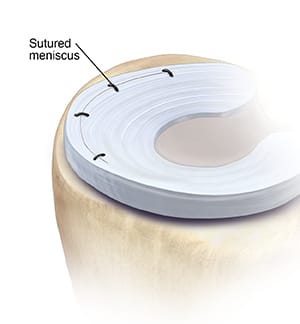
For certain tears, your surgeon will try to repair the meniscus. They will sew the torn edges so they can heal correctly. Or your surgeon will use special fasteners to repair damage. In some cases, repairs may need another incision at the back or side of your knee.
Removal
In most cases, your surgeon will remove the damaged part of your meniscus. The meniscus won't completely grow back, so your surgeon will remove as little tissue as possible. Other tissue, called the articular cartilage, will take over the role as shock absorber for your knee joint.
After surgery
You'll spend some time in the recovery area. You can go home when you've recovered from the anesthesia. Your knee will be bandaged. You may have stitches, surgical tape, or staples. You may need crutches to keep weight off the knee and may have a splint or brace for support.
Featured in
Online Medical Reviewer: Rahul Banerjee MD
Online Medical Reviewer: Raymond Turley Jr PA-C
Online Medical Reviewer: Stacey Wojcik MBA BSN RN
Date Last Reviewed: 09/01/2025
© 2000-2026 The StayWell Company, LLC. All rights reserved. This information is not intended as a substitute for professional medical care. Always follow your healthcare professional's instructions.
Find the Right Orthopedic & Sports Medicine Specialist for You
BLANCHARD VALLEY HEALTH SYSTEM
Ortho LinkRelated Articles
Hip Arthroscopy: Before Surgery
Learn more about hip arthroscopy and what you can do before your surgery.
Your Amputation Surgery
Amputation is surgery to remove a limb. Learn about the surgery and what to expect after.
Foot Surgery: Plantar Fascia Problems
Your plantar fascia is the ligament that extends from the heel of your foot to the ball of your foot. If your foot flattens too much or too little as you move, you may strain your plantar fascia. While the vast majority of people with plantar fascia pain can be helped with nonsurgical treatments, surgery can be considered if these treatments fail.
Kneecap (Patella) Surgery: Realignment
Some procedures may be done using arthroscopy, a method that uses tiny incisions and special instruments to look and work inside the knee joint. Other procedures need open surgery. The kneecap can be realigned to improve its tracking. To do this, soft tissue may be cut, tightened, or moved.