Surgery may be done if your carpal tunnel syndrome (CTS) symptoms become severe. Or you may have surgery if no other treatment eases your symptoms. There are two ways CTS surgery is done. You will be told which method will be used. You’ll also be instructed on how to prepare for it. And how care for yourself when you are at home.
The goals of surgery
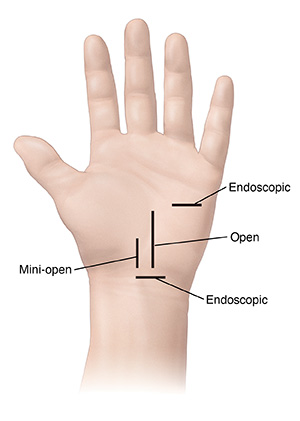
The 2 methods of surgery used to treat CTS are open and endoscopic.
-
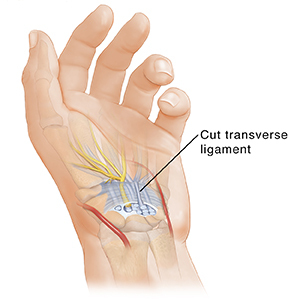
Open surgery. With open surgery, your surgeon makes a cut (incision) in your palm. Standard surgical tools are used to release the transverse carpal ligament.
-
Endoscopic surgery. For this surgery, your surgeon makes 1 or 2 small cuts in your hand or wrist. A thin tube with a very small camera attached (endoscope) is inserted under the carpal ligament. Tiny cutting tools are put in there as well. The surgeon then operates while watching images on a video screen. Each procedure has the same goal: Your surgeon will relieve pressure on the median nerve. To do this, the transverse carpal ligament is cut (released).
After surgery
After your surgery, you will be taken to the post-anesthesia care unit. You will be watched there for a few hours before you go home. Your vital signs, nerve sensation, and blood circulation in your hand will be checked at this time. For the safest healing at home, do the following:
-
Keep your hand raised above heart level. This will help reduce swelling.
-
Limit hand and wrist use as instructed. You may need a wrist brace.
-
Take any pain medicine as directed.
-
Do hand exercises as directed by your surgeon or therapist.
When to call the surgeon
Call your surgeon if you notice any of the following:
-
White or pale-blue hand or nails (you pinch your skin or nail and the color doesn’t return)
-
Pain that is not relieved by prescribed medicine
-
Loss of feeling or excess swelling in hand or fingers
-
Pus-like liquid oozing out of your wound
-
Fever over
100.4 °F (38° C)
Featured in
Online Medical Reviewer: Anne Fetterman RN BSN
Online Medical Reviewer: Marianne Fraser MSN RN
Online Medical Reviewer: Rita Sather RN
Date Last Reviewed: 03/01/2024
© 2000-2026 The StayWell Company, LLC. All rights reserved. This information is not intended as a substitute for professional medical care. Always follow your healthcare professional's instructions.
Find the Right Orthopedic & Sports Medicine Specialist for You
BLANCHARD VALLEY HEALTH SYSTEM
Ortho LinkRelated Articles
Surgery for Anterior Cruciate Ligament (ACL) Injury
The ACL (anterior cruciate ligament) is a band of tough, fibrous tissue that helps stabilize the knee. Injury to this ligament often happens when the knee is forced beyond its normal range of motion.
Kneecap (Patella) Surgery: Realignment
Some procedures may be done using arthroscopy, a method that uses tiny incisions and special instruments to look and work inside the knee joint. Other procedures need open surgery. The kneecap can be realigned to improve its tracking. To do this, soft tissue may be cut, tightened, or moved.
Foot Surgery: Flexible and Rigid Hammertoes
With hammertoes, one or more toes curl or bend abnormally. This can be caused by an inherited muscle problem, an abnormal bone length, or poor foot mechanics. There are many nonsurgical treatments for hammertoes, but if these are not effective, you may want to consider surgery.
Understanding Achilles Tendon Repair Surgery
Achilles tendon repair surgery is a type of surgery to fix a damaged Achilles tendon.