Improving your flexibility can reduce pain. Stretching exercises can also help increase your range of pain-free motion. Breathe normally when you exercise. Try to use smooth, fluid movements. Never force a stretch. Always talk with your healthcare provider before starting this exercise.
-
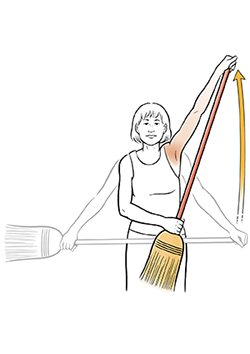
Stand up or lie on the floor. Place the palm of your hand over the end of a yardstick, broom, or cane. Grasp the stick farther down with the other hand, palm facing down.
-
Push the end of the stick up on the side of your injured shoulder until you feel a stretch.
-
Hold for a few seconds. Return to the starting position.
-
Repeat
3 to 5 times. Build up to holding each stretch for10 to 30 seconds.
Note: Follow any special instructions you are given. If you feel pain, stop the exercise. If the pain continues after stopping, call your healthcare provider.
Online Medical Reviewer: Daphne Pierce-Smith RN MSN
Online Medical Reviewer: Thomas N Joseph MD
Online Medical Reviewer: Trina Bellendir PT
Date Last Reviewed: 09/01/2023
© 2000-2026 The StayWell Company, LLC. All rights reserved. This information is not intended as a substitute for professional medical care. Always follow your healthcare professional's instructions.
Find the Right Orthopedic & Sports Medicine Specialist for You
BLANCHARD VALLEY HEALTH SYSTEM
Ortho LinkRelated Articles
Sling
A sling is designed to support your arm in a position of rest. It is used for injuries of the hand, forearm, upper arm, and shoulder.
Walker Boot
Aircast Walker boot is a short boot that supports and protects the foot and ankle while allowing you to walk.
Leg Muscle Stretches: Knee Flexion
The following flexibility exercise may be suggested by your therapist. Repeat as many times as instructed. Stop the exercise if it causes pain, and discuss it with your physical therapist or healthcare provider:
Sling and Swathe
Sling and swathe is used to support your arm and hold it closely against your body after an injury.