Cancer happens when cells in the body change. They grow out of control and don't work the way they should. Cancer that starts in blood cells in the bone marrow and spreads to the bloodstream is called leukemia.
Understanding the blood
Blood is made up of cells and fluid. The body is always making new blood cells to keep the blood healthy. New blood cells are made in the bone marrow. This is the spongy, thick liquid that's inside bones. The major types of blood cells are:
-
White blood cells. They help the body fight infections and disease.
-
Red blood cells. They carry oxygen from the lungs to all parts of the body. They also carry carbon dioxide back to the lungs.
-
Platelets. They help form blood clots and stop bleeding.
When leukemia forms
Leukemia is a cancer of the white blood cells. The cells involved are not mature, and they don't function correctly. The cancer usually starts in the bone marrow where white cells are made or in the lymph nodes. With leukemia, the body makes a lot of white blood cells that don't work the way they should, so they can't fight infections. Over time, the abnormal leukemia cells crowd out the normal cells in the bone marrow. Normal, healthy blood cells are no longer made. The abnormal white cells spill into the bloodstream.
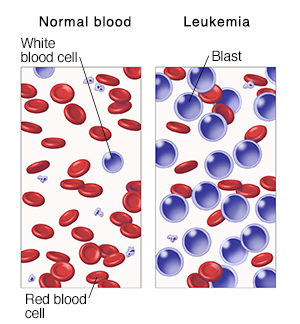
There are four major subtypes of leukemia. They are defined by the gene mutations and specific bone marrow cells involved.
-
Acute lymphocytic leukemia (ALL)
-
Acute myeloid leukemia (AML)
-
Chronic lymphocytic leukemia (CLL)
-
Chronic myeloid leukemia (CML)
Definitions:
-
Acute or chronic. Acute leukemia grows very quickly. Chronic leukemia tends to be slow growing, but it may get worse over time.
-
Myeloid (myelocytic) or lymphoid (lymphocytic). These refer to the subtype of white blood cell that the cancer starts in.
Treatment choices for leukemia
You and your health care provider will decide on a treatment plan that's best for you. The main treatments for leukemia are:
-
Chemotherapy. This uses strong medicines to kill cancer cells.
-
Targeted therapy. This uses medicines that attack parts of leukemia cells that make them different from normal cells.
-
Immunotherapy. This works with or like the body's own immune system to help fight cancer.
-
Stem cell transplant. This destroys the tissues or cells that make blood cells and replaces them with healthy tissues or cells.
-
Radiation therapy. This uses strong beams of energy to help prevent or treat leukemia in certain parts of the body.
Treatment depends on many things, such as the type of leukemia you have, your overall health, whether there's a stem cell match for you, and your preferences.
Featured in
Online Medical Reviewer: Jessica Gotwals RN BSN MPH
Online Medical Reviewer: Sabrina Felson MD
Online Medical Reviewer: Todd Gersten MD
Date Last Reviewed: 04/01/2025
© 2000-2026 The StayWell Company, LLC. All rights reserved. This information is not intended as a substitute for professional medical care. Always follow your healthcare professional's instructions.

Related Articles
What Is Non-Hodgkin Lymphoma?
Non-Hodgkin lymphoma is a type of cancer. Learn about how it forms and treatment choices.
Gastrointestinal Stromal Tumor (GIST)
A gastrointestinal stromal tumor is a rare type of cancer. It occurs in the gastrointestinal or digestive tract.
Chemotherapy and Liver Toxicity
Although chemo is good at killing cancer cells, it can also harm healthy cells and organs. That includes your liver.
External Beam Radiation Therapy: Understanding Your Treatment and Care
Radiation therapy is a treatment for cancer. It uses targeted high-energy X-rays or particles to destroy cancer cells.