Round ligament pain is a common problem in pregnancy. Ligaments are strong tissues that connect bones, muscles, and organs. There are two round ligaments. There is one on each side of the uterus. The top part of each ligament attaches to the upper side of the uterus. The bottom of each ligament attaches down in the pubic area. These ligaments help keep the uterus in place as you move around.
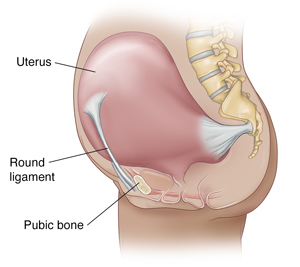
What causes round ligament pain in pregnancy?
As your uterus grows during pregnancy, the round ligaments are stretched and work harder when you move around. They may stretch too quickly when you stand up or bend or laugh. Nearby nerves may be irritated, or the ligaments may have a painful spasm.
Symptoms of ligament pain in pregnancy
The symptoms are sharp pains that last a few seconds. The pain may happen most often on the right side of the belly. It may happen in the hip, the lower belly, or even deep down in your pubic area. The pain may happen when you:
-
Move suddenly
-
Stand up
-
Walk
-
Roll over in bed
-
Laugh
-
Cough
-
Sneeze
Diagnosing round ligament pain in pregnancy
Your healthcare provider will ask about your symptoms and give you a physical exam. They may give you tests to check for other problems that can cause pain, such as an ovarian cyst or enlarged vein (varicocele). They will also check for signs of preterm labor or other pregnancy problems.
Treatment for round ligament pain in pregnancy
To help prevent pain:
-
Move slowly when you stand up, roll over, turn, or bend.
-
Don’t stand for long periods of time.
-
Don’t lift heavy objects.
-
Do gentle daily stretches of your hip joints.
When to call your healthcare provider
Call your healthcare provider right away if you have any of these:
-
Fever of 100.4°F (38°C) or higher
-
Pains that last more than a few minutes
-
Pain that gets worse
-
Bleeding, nausea, vomiting, or other new symptoms
Featured in
Date Last Reviewed: 09/01/2025
© 2000-2026 The StayWell Company, LLC. All rights reserved. This information is not intended as a substitute for professional medical care. Always follow your healthcare professional's instructions.

Related Articles
Diabetes: After Delivery (Postpartum)
Pregnancy changes your body in many ways. If you have diabetes, pregnancy can also change how your body uses insulin. You’ll need to adapt your diabetes management plan before, during, and after giving birth. Your doctor will work with you to help you keep diabetes under control.
Understanding Fecal Incontinence After Pregnancy (Postpartum)
Fecal incontinence is when you accidentally leak stool. It often occurs after vaginal birth.
Dizziness or Fainting During Pregnancy
Feeling dizzy or faint is very common during pregnancy. It generally does not mean something is wrong. It is most common during the first trimester, but it can happen anytime during pregnancy. Dizziness and fainting (syncope) are often caused by a drop in blood pressure. This is from the hormones released during pregnancy that relax the body's blood vessels. Too little blood is then pumped up to the brain. When this happens, you lose consciousness (faint). Fainting is not dangerous to you or your baby unless you fall and hurt yourself.
Discharge Instructions for Hydatidiform Mole (Molar Pregnancy)
You have been diagnosed with a hydatidiform mole (also called a molar pregnancy). You and your doctor have decided on dilatation and curettage (D&C) to remove the mole. Here are guidelines to follow at home after the procedure.