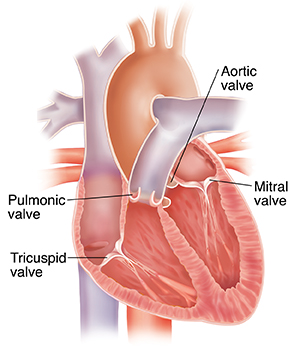
The heart has four valves. They are the aortic, pulmonary, tricuspid, and mitral valves. The valves open and close to keep blood moving in the right direction through the heart. Blood moves through the heart as it beats. With each squeeze, the valves open and close to keep blood moving forward. In this way, valves keep blood moving as well as possible through the heart. They also prevent backflow.
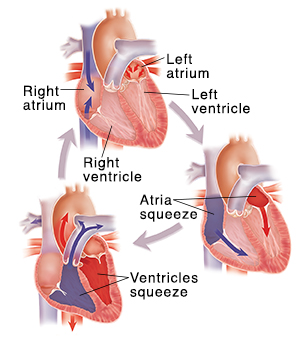
When the heart relaxes between beats:
-
Oxygen-rich blood from the lungs fills the left atrium.
-
Oxygen-poor blood from the body fills the right atrium.
When the atria beat:
-
The left atrium squeezes. This pushes blood through the mitral valve into the left ventricle.
-
The right atrium squeezes. This pushes blood through the tricuspid valve into the right ventricle.
When the ventricles beat:
-
The left ventricle squeezes. This pushes blood through the aortic valve out to the heart arteries, the brain, and body.
-
The right ventricle squeezes. This pushes blood through the pulmonary valve to the lungs.
Online Medical Reviewer: Glenn Gandelman MD MPH
Online Medical Reviewer: Lu Cunningham RN BSN
Date Last Reviewed: 08/01/2023
© 2000-2026 The StayWell Company, LLC. All rights reserved. This information is not intended as a substitute for professional medical care. Always follow your healthcare professional's instructions.

Related Articles
Heart Attack
A heart attack happens when the blood supply is cut off from the heart muscle, usually because of a blood clot. Without blood and oxygen, the muscle cells are damaged and die.
Carotid Artery Problems: Stroke
When the carotid arteries are healthy, the brain gets all the oxygen and nutrients it needs to function well. If the carotid arteries are damaged, however, it can greatly increase your chances of stroke.
Left-sided heart failure
Left-sided heart failure can cause shortness of breath and trouble breathing. Learn about treatment and home care for this condition.
Bacterial Endocarditis
Bacterial endocarditis is a bacterial infection of the inner layer of the heart or the heart valves. Read on to learn about the cause, symptoms, diagnosis, and treatment.