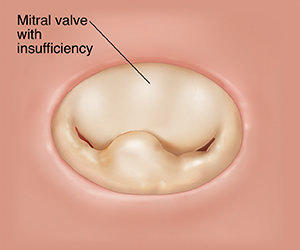
Mitral insufficiency means your mitral valve has problems closing. This lets blood leak back through the valve.
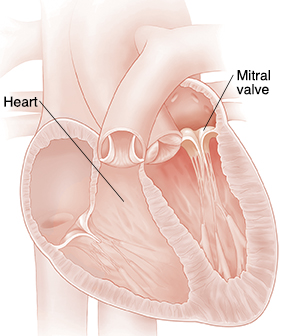
The heart has 4 valves. These valves help blood flow through the heart and out to the body by promoting forward flow and preventing back flow. The mitral valve lies between the 2 chambers of the heart on the left side. These 2 chambers are the left atrium and left ventricle. When the valve is open, it allows blood to flow from your lungs and left atrium to your left ventricle. When the left ventricle contracts to pump blood into your body, the mitral valve closes to prevent blood from leaking backward.
With mitral insufficiency, a small amount of leaking blood rarely leads to problems. But if the leaking is severe, it can cause damage to and enlargement of the heart. That's because the leaking of blood means the blood has to be pumped twice.
Possible causes of mitral insufficiency
Causes may include:
-
Heart damage from rheumatic fever or other infections or diseases
-
Aging
-
Mitral valve prolapse
-
Damage after a heart attack
Treating mitral insufficiency
Medicines may be prescribed. These help the heart work better. In severe cases, heart valve surgery may be needed to repair or replace the valve.
Online Medical Reviewer: Robyn Zercher FNP
Online Medical Reviewer: Ronald Karlin MD
Online Medical Reviewer: Stacey Wojcik MBA BSN RN
Date Last Reviewed: 08/14/2004
© 2000-2026 The StayWell Company, LLC. All rights reserved. This information is not intended as a substitute for professional medical care. Always follow your healthcare professional's instructions.

Related Articles
Understanding Venous Thromboembolism
Venous thromboembolism is when a blood clot forms in a vein. The term refers to two linked conditions: deep vein thrombosis (DVT) and pulmonary embolism.
Heart Valve Problems: Aortic Stenosis
Aortic stenosis means your aortic valve has a problem opening. The left ventricle has to work harder to push the blood through the valve. In some cases, this extra work will make the muscle of the ventricle thicken. This type of stenosis can quickly get worse.
Pericarditis
Pericarditis is inflammation of the pericardium, the thin sac that surrounds the heart. Read on to learn details, such as causes, symptoms, diagnosis, treatment, and complications.
Aortic Valve Regurgitation
Aortic valve regurgitation is when a person's aortic valve leaks. The aortic valve is 1 of the heart's 4 valves. These valves help the blood flow through the heart and out to the body. Normally, the aortic valve stops blood from flowing back into the left ventricle. With aortic valve regurgitation, some blood leaks back through the valve as the heart relaxes.