A nevus is a colored growth on your eye. It’s much like a mole on your skin. It's sometimes called an eye freckle.
Nevi are common. They are rarely cancer. But in some cases, they can turn into melanoma, a type of cancer.
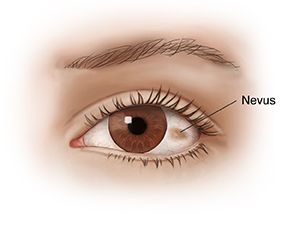
What causes a nevus?
A nevus can occur when cells called melanocytes clump together in your eye. These cells are normally spread out. They make a pigment called melanin. This pigment gives your eyes, skin, and hair their color.
Being exposed to ultraviolet (UV) light may raise your risk of developing a nevus. You can lower that risk by wearing sunglasses that absorb at least 99% of UV rays. Sometimes nevi run in families.
Symptoms of a nevus
A nevus often appears as a dark-colored spot on the eye. It may be brown or yellow in color. It can grow on different parts of the eye, including the:
-
Clear membrane that covers the eye (conjunctiva)
-
Colored part of the eye (iris)
Some nevi grow inside the eye on the choroid. This is a layer of tissue under the retina. These growths are called choroidal nevi. They can be seen only by an eye care provider during an eye exam. They may appear yellow or brown, or other colors.
Treatment for a nevus
Most nevi don’t need treatment. But there is a chance a nevus, especially one inside the eye, can turn into melanoma. For this reason, your eye care provider will likely watch the nevus over time for changes. You may need regular eye exams.
Your eye care provider may also use an imaging test called optical coherence tomography. This test uses light waves to make detailed images of the retina and helps determine if the nevus has changed in size or shape.
If the nevus becomes cancer, you will need treatment. Your eye care provider may advise surgery, radiation, or laser therapy. In some cases, the side effects of cancer treatment may cause more problems. Your eye care provider may then choose to wait and watch to see if the nevus gets worse.
When to call your healthcare provider
Call your eye care provider right away if:
-
The nevus changes in color or shape
-
You feel eye pain
-
You start to have problems with your vision, such as flashing lights
-
You notice a new spot on your eye
Date Last Reviewed: 09/01/2025
© 2000-2026 The StayWell Company, LLC. All rights reserved. This information is not intended as a substitute for professional medical care. Always follow your healthcare professional's instructions.
Related Articles
Corneal Ulcer
A corneal ulcer is an open sore on the cornea. A corneal ulcer may cause redness, pain, increased tears, and pus or mucus draining from the eye. It may also cause blurry vision and swelling of the eyelid.
Ocular Histoplasmosis Syndrome
OHS is a disease that can lead to vision loss. It is caused by a fungus. Learn more about the signs and symptoms of OHS, plus how it is treated.
Iritis
Iritis is an inflammation of the iris. It can be caused by injury to the eye or disease elsewhere in the body. Symptoms include redness, pain in the eye or brow region, sensitivity to light, and blurred vision.
Acquired Brown Syndrome (Superior Oblique Tendon Sheath Syndrome)
Brown syndrome is a problem with a tendon that attaches to the eyeball. In Brown syndrome, this tendon can’t move freely. This limits the eye’s normal movement. Brown syndrome is a rare disorder. It is usually present at birth (congenital). In some cases, it occurs later in life (acquired).