A fistulogram is a type of X-ray. It uses X-ray dye (contrast) to look inside your arteriovenous (AV) fistula vascular access for hemodialysis. It’s done to check the blood flow and look for any narrowing (stenosis) in the vein of your fistula. If a narrowing is found, then an angioplasty can be done at the same time. This procedure makes the vein wider using a small, inflatable balloon. Fistulogram and angioplasty are both outpatient procedures. This means you’ll go home the same day.
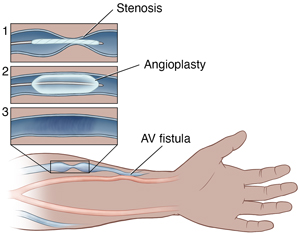
Why is a fistula and angioplasty done?
This procedure may be advised if you have any signs that your AV fistula isn’t working well due to a narrowed blood vessel. This can include:
-
Reduced blood flow.
-
Little or no bruit, the sound of blood flowing in your AV fistula.
-
Changes in the thrill, the pulse at the fistula site.
-
The arm with the fistula gets swollen.
-
Bleeding from your access after your dialysis session.
-
During dialysis sessions, the dialysis machine alarms go off because of access flow issues.
Before the procedure
-
Follow any directions you’re given for not eating or drinking before the procedure.
-
Tell your doctor about all of the medicines you take. This includes prescription and over-the-counter medicines, vitamins, minerals, and supplements.
-
Tell the doctor if you have allergies to any medicines or to X-ray dye.
-
Tell the doctor if you’re pregnant or think you may be pregnant.
-
Arrange for someone to drive you home after the procedure.
During the procedure
In general, here’s what you can expect during a fistulogram and angioplasty:
-
You’ll lie down on an X-ray table.
-
You may be given medicine to relax you (sedatives) in the arm opposite your fistula.
-
The doctor injects some medicine (local anesthesia) into the fistula arm to numb the area.
-
The doctor inserts a long, thin tube (catheter) into your access.
-
Contrast dye is added to the catheter while X-ray images are taken. The X-ray images let the doctor see how the dye flows. They can see if there’s any narrowing.
-
If there’s no narrowing, then the catheter is removed. Pressure is applied to the insertion site until any bleeding stops.
If an angioplasty is needed:
-
If a blood vessel is narrowed, an angioplasty will be done at the same time.
-
Using a thin guide wire, the provider inserts a small, inflatable balloon into the catheter.
-
The doctor inflates the balloon into the narrow part of the blood vessel. This makes the vessel wider so that more blood can flow through. You may feel some mild discomfort.
-
When the procedure is done, both the wire and balloon are removed.
-
The doctor injects contrast dye into the catheter to check that blood flow is improved.
-
The catheter is removed.
-
Pressure is applied to the insertion site until any bleeding stops.
-
You may have 1 or 2 stitches at the insertion site. These will be removed at your next dialysis session.
After the procedure
-
You’ll be moved to a recovery area. Your heart rate, blood pressure, and fistula will be checked.
-
If no angioplasty was done, you’ll go home right away.
-
If you had an angioplasty, you’ll stay and be watched for a few hours.
-
Make sure someone is available to drive you home.
-
Once you are home, relax for the rest of the day.
-
Don’t lift anything heavy or do any strenuous activities for 24 hours.
-
Drink fluids to help flush the X-ray dye from your body.
-
Follow any other directions from your doctor.
Risks of fistulogram and angioplasty
All procedures have some risk. Possible risks of fistulogram and angioplasty are:
-
A blood vessel that ruptures.
-
A blood vessel that spasms.
-
Bleeding or infection at the insertion site.
-
Problems because of X-ray dye, such as an allergic reaction.
-
The blood vessel becomes narrowed again.
When to contact your doctor
Contact your doctor if any of these occur after the procedure:
-
You have signs of infection, such as redness, swelling, warmth, or fluid leaking from the insertion site.
-
You can’t feel your thrill (the pulse at the fistula site).
-
Your thrill feels very weak.