Your health care provider says that you need intermittent catheterization (IC). IC involves temporarily placing a tube (catheter) into the urethra to drain urine from the bladder. The urethra is the tube that carries urine out of the body. IC is also called "in and out" catheterization. Once the bladder is empty, the catheter is removed. Learning how to correctly care for your catheters helps keep them clean for you to use. This helps prevent infection.
Types of catheters
Catheters are made of soft, flexible plastic, rubber, or silicone. They come in all shapes and sizes. Some are disposable and are used once and thrown away. Others can be used many times if cleaned correctly. Ask your provider how often the catheter you use should be replaced. Follow your provider’s instructions carefully.
Catheter care
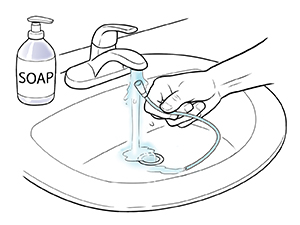
If you use a disposable catheter, use a new one each time you empty your bladder. Throw the catheter away when you’re done. If your catheters are reusable, do the following after each use:
-
Wash your hands with soap and warm water.
-
Clean the catheter with soap and warm water.
-
Rinse the catheter, making sure there is no soap left inside or on it.
-
Dry the outside of the catheter.
-
Store the catheter in a clean, dry container, such as a resealable plastic bag.
-
Throw away a catheter if the plastic looks cloudy.
-
Wash your hands again.