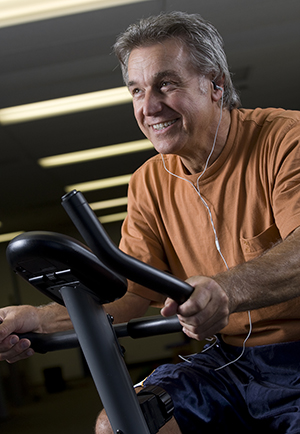
After surgery, your joint may be swollen, painful, and stiff. Your recovery time will depend on what was done. Your surgeon will tell you when to resume activity and weight-bearing. If you had meniscal cartilage or loose bodies removed, you may be told to bear weight early on. You may be told to ride an exercise bike to restore your knee's motion and strength. After ACL repair, don't pivot or make sudden moves.
At home
Follow your surgeon’s guidelines for healing:
-
Raise (elevate) your knee as much as possible and ice your knee for 20 minutes at a time. Then allow at least 20 minutes before the next icing session. To make an ice pack, put ice cubes in a plastic bag that seals at the top. Wrap the bag in a thin towel or cloth. Don’t put ice or an ice pack directly on the skin.
-
Limit weight-bearing, if advised to do so. Your surgeon will tell you how much weight to put on your knee. Physical therapy may be prescribed.
-
Keep your knee bandaged according to your surgeon's instructions.
-
Your surgeon will tell you when you can shower or bathe. When you shower, wrap your knee with plastic to keep it dry.
-
Take pain medicine as directed. You may be on a combination of medicines, such as opioids, non-steroidal anti-inflammatory drugs (NSAIDs), and local anesthesia (called a "block"). Some pain is normal. Your healthcare team will help you know what is expected.
-
Follow your surgeon's instructions on taking medicine, like aspirin, to decrease the risk of blood clots.
-
Your surgeon will let you know when you can drive or operate machinery. This may be between
1 to 3 weeks.
Your checklist
The checklist below helps remind you what to do after knee arthroscopy.
☐ Schedule your first follow-up visit for
☐ Take care of your incision, and bathe as directed.
☐ Complete your physical therapy program.
☐ Talk with your surgeon about activities you can do right away and those that need to wait.
Call 911
Call 911 if you have any of these:
-
Chest pain
-
Shortness of breath or feeling you can't get enough air
-
Feeling lightheaded, faint, or dizzy
When to call your healthcare provider
Contact your healthcare provider right away if any of these occur:
-
Fever of 100.4°F (38°C) or above, or as directed by your provider
-
Chills
-
Lasting warmth or redness around the knee
-
Lasting or increased pain
-
Severe swelling in your knee
-
Increasing pain, swelling, or redness in your calf muscle
-
Knee stiffness that gets worse.
Find the Right Orthopedic & Sports Medicine Specialist for You
BLANCHARD VALLEY HEALTH SYSTEM
Ortho LinkRelated Articles
After Ankle Arthroscopy
After ankle arthroscopy, your joint may be swollen, painful, and stiff. Recovery times can vary. Your surgeon will tell you when to resume activity.
Taking Care of Your Limb After Amputation
Soon after surgery, you’ll be taught how to take care of your residual limb. This is the part of your limb that remains after amputation. Follow all directions from your care team closely.
Headache After Spinal Tap (No Patch)
If there is a loss of too much spinal fluid from a leak at the puncture site after a spinal tap, the spinal fluid pressure goes down and a headache occurs. This headache may be mild or severe. There may also be dizziness, nausea and blurred vision. Here's what you need to know.
Patella (Kneecap) Dislocation or Subluxation, Reduced
The kneecap is held in place by ligaments and tendons. If the kneecap is hit with a strong force, it can slide too far to the side of the knee joint, tearing these ligaments and tendons. This sliding is called subluxation or dislocation.