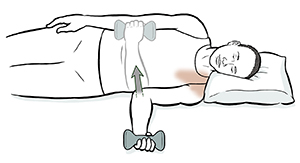
This shows the exercise for your right shoulder. Switch sides for your left shoulder.
-
Put a hand weight on the floor. Your healthcare provider will tell you what size hand weight to use. Usually start with about
1- to 2-pound weights. -
Lie on the floor on your side. Keep your upper arm extended on your side. Support your head and neck with a pillow or small folded towel to keep your neck and spine straight.
-
With your hand closest to the floor, hold the hand weight and let your arm rest on the floor at a right angle. This is your starting position.
-
Slowly raise the hand weight toward your chest, keeping your elbow bent at a right angle the entire time.
-
Slowly lower the hand weight back to the starting position on the floor. Keep your elbow bent at a right angle.
-
Repeat this exercise
8 to 10 times for2 sets, or as instructed. As you get stronger, repeat the exercise5 times for3 sets. As the exercise becomes easier, add weight,1 pound at a time up to5 pounds, and start again with2 sets of8 to 10 repetitions.
Tip
Keep your body still while you raise the weight. Don't roll back.
Author: Wheeler, Brooke
© 2000-2026 The StayWell Company, LLC. All rights reserved. This information is not intended as a substitute for professional medical care. Always follow your healthcare professional's instructions.
Find the Right Orthopedic & Sports Medicine Specialist for You
BLANCHARD VALLEY HEALTH SYSTEM
Ortho LinkRelated Articles
Back Care Tips
Read on for things you can do to prevent acute back pain from coming back, and to reduce chronic back pain symptoms.
Quadruped Hip Abduction (Strength)
This exercise helps strengthen your quads.
Standing with Crutches (Non-Weight Bearing)
These images show you how to stand using crutches.
Self-Care for Strains and Sprains
Most minor strains and sprains can be treated with self-care. But if you have torn tissue or damaged blood vessels, nerves, or bones, be sure to call your healthcare provider.