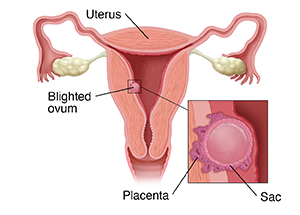
Blighted ovum is a type of early pregnancy loss. It’s also called anembryonic pregnancy or empty sac. You have a placenta and a gestational sac, but the embryo doesn’t grow. The placenta and sac still give off pregnancy hormones. These cause a pregnancy test to show positive. And you may continue to have pregnancy symptoms. Because of this, the pregnancy loss often isn’t found until an ultrasound is done later in pregnancy.
How to say it
BLI-tehd OH-vuhm
What causes blighted ovum?
In most cases, the cause is abnormal chromosomes in the fertilized egg. Other possible causes include:
-
An infection.
-
An autoimmune disease in the parent.
-
An endocrine disease in the parent.
-
Tissue that divides the inside of the uterus into sections (septum).
Symptoms of blighted ovum
Symptoms of blighted ovum include:
-
Mild cramps in your lower belly.
-
Light bleeding from the vagina called spotting.
Treatment for blighted ovum
After a pregnancy loss, the placenta and sac need to leave the body. The process can cause pain and bleeding. This can happen on its own, or your body may need help. Your health care provider may advise any of the treatments below:
-
Expectant management. This means to watch and wait. If it’s safe for you, your provider may advise waiting several weeks to see if the placenta and sac are released from your uterus on their own.
-
Medicine. The medicine misoprostol can help the process. You may take the medicine by mouth. Or it may be put into your vagina. You may also be given pain medicine to help lessen cramping.
-
Uterine evacuation/curettage. You are given pain medicine, plus medicine to help you relax and feel sleepy. A tube is put through the opening of the vagina and cervix. The tube is attached to a vacuum device. The device creates suction that helps remove the tissue. In some cases, a tool called a curette is used to help loosen tissue in the uterus.
After or during the treatment, you may need to have an ultrasound test. This is to make sure all the tissue has left your body.
You may also need emotional support during and after this process. Losing a pregnancy can be very upsetting. Talk with your provider and your family to get support if you need it during this time. You may want to speak with a counselor or attend a support group. Make sure to ask for any help you need.
Possible problems from blighted ovum
Possible problems can occur from treatment. These include:
-
Excess bleeding.
-
Infection.
-
Scar tissue.
-
Tear in the uterus (perforation).
When to contact your health care provider
Contact your provider right away if you have:
-
A lot of bleeding from your vagina.
-
Dizziness or fainting.
-
Fever of 100.4°F (38°C) or higher, or as directed by your provider.
-
Other symptoms that don’t get better or get worse.
-
Severe pain that isn’t helped with pain medicine.
Author: Wheeler, Brooke
© 2000-2026 The StayWell Company, LLC. All rights reserved. This information is not intended as a substitute for professional medical care. Always follow your healthcare professional's instructions.
Related Articles
Twins and Premature Birth
If you're pregnant with twins, you'll want to carefully consider this advice. It can help increase your chances for a full-term pregnancy.
What Is Prenatal Care?
Before becoming pregnant, you may have adopted good health habits to get ready for your baby. But if you didn't, start today. Read on to learn more.
Cervicitis
Cervicitis is irritation or infection of the cervix. It can be caused by a number of different sexually transmitted diseases.
Breastfeeding FAQs
Here are answers to some common questions about breastfeeding.