CVS is a prenatal test that checks for certain genetic conditions in the fetus using a sample taken from the placenta. The placenta usually has the same genes as the fetus. The test is most often done between 10 and 14 weeks of pregnancy. Discuss with your doctor whether CVS is right for you.
Should you have CVS?
CVS is a diagnostic prenatal test that can find out if a fetus has chromosome or gene problems. These problems may cause conditions, such as Down syndrome, Edward syndrome, sickle cell disease, cystic fibrosis, and Tay-Sachs disease. CVS does not diagnose heart disease or spina bifida. The following risk factors can increase chances of fetal gene problems:
- You're 35 or older.
- Your family has a history of inherited (genetic) problems.
- Other tests, such as abnormalities on an ultrasound, have shown that the fetus may have health problems.
How CVS is done
CVS is an invasive test. It is done by a doctor with special training. The test can be done through your belly (transabdominal). Or it may be done through your cervix (transcervical). It's common to feel some cramping during and after the CVS test.
Transabdominal CVS
- The doctor puts a needle through your belly (abdomen) and into the uterus.
- The doctor uses ultrasound to guide the needle into the placenta. Ultrasound uses sound waves to make an image on a screen.
- The doctor takes a small amount of tissue from the placenta with a syringe.
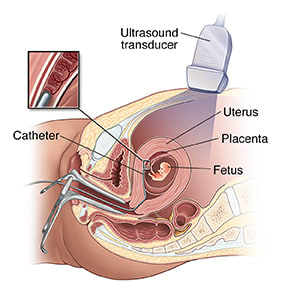
Transcervical CVS
- First, the fetus is located with ultrasound.
- The doctor puts a thin tube into your vagina and guides it to your uterus.
- The doctor removes a small amount of cells from the tissue that will become the placenta (chorionic villi) by gentle suction.
You can go home right after the test. But you may need to take it easy for a day or so.
When to contact your doctor
There is a small risk of miscarriage after CVS. Contact your doctor right away if you notice:
- Severe pain or cramping.
- Vaginal bleeding (spotting).
- Fever or chills.
- Fluid leaking from your vagina.
Getting test results
When you will get your test results can vary, but results are usually ready in about 2 weeks. CVS is a very accurate test, but in a few cases, results may be inconclusive. You and your doctor will go over the results together. Depending on the results, you will talk about the next steps to take.

Related Articles
Amniocentesis
Amniocentesis is a procedure used to take out a small sample of the amniotic fluid for testing.
Fetal Ultrasound
Fetal ultrasound is a test used during pregnancy to create an image of the baby in the uterus. Read on to learn more.
Understanding Fetal Echocardiography
Fetal echocardiography is a tyest that shows pictures of the baby's heart before birth. It is done to check for problems in the baby's heart structure, function, or rhythm.
Understanding a Multiple Pregnancy
A multiple pregnancy is usually found early in the pregnancy so that good prenatal care can begin. Read on to learn more.