Your treatment will depend on how inflamed your tendon is. The goal is to ease your symptoms and help you regain full use of your elbow.
Rest and medicine
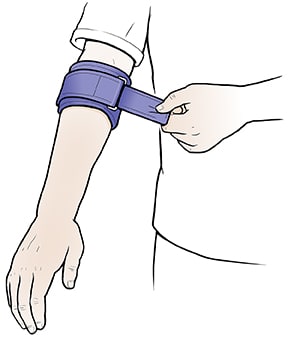
Wear a tennis elbow splint to let the inflamed tendon rest and heal. It must be worn correctly. It should be placed down the arm past the painful area of the elbow. It can make symptoms worse if it's directly over the inflamed tendon. Take stress off the tendon by using your other hand or changing your grip. Take NSAIDs (nonsteroidal anti-inflammatory drugs) for pain and inflammation. Talk with your doctor before taking these if you have chronic liver or kidney disease or had a stomach ulcer or digestive bleeding. Also talk with your doctor if you take a blood thinner.
It may be helpful to use an ice pack for the first
Exercises and therapy
Your doctor may give you an exercise program. They may send you to a physical therapist. That expert will teach you how to gently stretch and strengthen the muscles around your elbow.
Anti-inflammatory shots
Your doctor may give you shots of an anti-inflammatory medicine, such as cortisone. This helps ease swelling. You may have more pain at first. But your elbow should feel better in a few days.
Another option is a shot called PRP or platelet rich plasma. This is a specialized injection that uses a sample of your own blood to inject growth factors into the damaged tendon to try to allow it to heal.
If surgery is needed
If your symptoms go on for a long time, or other treatments don't work, your doctor may recommend surgery. Surgery releases the inflamed tendon, taking the tension off the tendon.
Find the Right Orthopedic & Sports Medicine Specialist for You
BLANCHARD VALLEY HEALTH SYSTEM
Ortho LinkRelated Articles
Preparing for Back Surgery
Plan ahead for both your surgery and recovery. Be sure to follow any instructions you are given. And talk to your doctor if you have questions about surgery or how the procedure will be done.
Hip Arthroscopy: Before Surgery
Learn more about hip arthroscopy and what you can do before your surgery.
Your Amputation Surgery
Amputation is surgery to remove a limb. Learn about the surgery and what to expect after.
Foot Surgery: Bunions
A bunion is a bony bump. When the distance between the first and second metatarsal bones of the foot is greater than normal, the big toe may turn toward the other toes. A mild bunion may then form causing foot pain and swelling. Bunions are most often found near the joint at the base of the big toe. Bunions tend to run in families. They may cause pain, swelling, and skin irritation.