A fractured bone starts to heal on its own right away. But a treatment called reduction may help the break heal correctly. Reduction is a process that repositions or "sets" the fracture. The goal is to get the broken bone ends as close as possible to how they were before the injury. Your healthcare provider will use one or more methods of reduction.
Closed reduction
If you have a clean break with little soft tissue damage, closed reduction will likely be used. Before the procedure, you may be given medicine to numb the area and relax your muscles. Then your healthcare provider manually readjusts the broken bone. You will wear a splint or a cast while you heal.
Open reduction
Open reduction with internal fixation is a surgical procedure that may be used in cases of displaced or unstable fractures, fractures involving one of the joints in the hand, or open fractures. (An open fracture is one in which the skin is disrupted over a fracture, either because the bone has poked through the skin, or there is a wound over a fracture.) You may have general anesthetic during the surgery to let you sleep and relax your muscles. Or you may have local or regional anesthesia to numb the area involved. Your surgeon then makes one or more cuts (incisions) to realign the bone and fix soft tissues. Pins, screws, plates, or a combination may be used to hold the bone in place during healing.
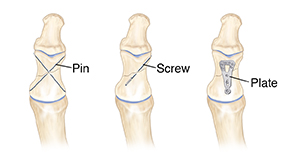
The road to healing
Fractures may take from 4 weeks to 4 months to heal. It depends on the bone and the severity of your injury. Keeping your hand raised can help control swelling, throbbing, and pain. Your healthcare provider may give you medicine to help ease pain. Don’t remove a splint or cast unless your healthcare provider says you can. Call your healthcare provider if your pain gets worse or if you notice lots of swelling or redness.
Find the Right Orthopedic & Sports Medicine Specialist for You
BLANCHARD VALLEY HEALTH SYSTEM
Ortho LinkRelated Articles
Treating Ankle Fractures
Treatment depends on where and how badly your ankle has been broken. A cast may be used to hold the bone in position for healing.
Foot Surgery: Flexible and Rigid Hammertoes
With hammertoes, one or more toes curl or bend abnormally. This can be caused by an inherited muscle problem, an abnormal bone length, or poor foot mechanics. There are many nonsurgical treatments for hammertoes, but if these are not effective, you may want to consider surgery.
Microdiskectomy
During a microdiscectomy, some disk is removed. In most cases, bone must first be removed to expose the damaged disk. The part of the disk outer wall and soft center that presses on the nerve can then be removed. There is usually enough disk remaining to cushion the vertebrae.
Patella (Kneecap) Dislocation or Subluxation, Reduced
The kneecap is held in place by ligaments and tendons. If the kneecap is hit with a strong force, it can slide too far to the side of the knee joint, tearing these ligaments and tendons. This sliding is called subluxation or dislocation.