An epidural is a way to give anesthetic. This is a medicine that blocks pain. For an epidural, the anesthetic is injected into the lower spine. It can be used to ease the pain of labor and delivery. This is done by an anesthesiologist. Or it may be done by a nurse anesthetist.
How pain is blocked
The spinal cord is the main path for pain signals. These signals travel from nerves through the spinal cord to your brain. The brain registers them as pain. The epidural blocks the signals in the nerves in your lower spine.
Numbing your lower body
Anesthetic is injected through the skin of your back into the part of the spinal canal called the epidural space. This blocks nerves below the place where it's injected. It can reduce pain or block most feeling. You will be awake. You will still have feeling in your upper body.
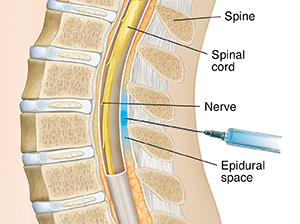
When you have an epidural
To have an epidural:
-
You may be asked to lie on your side. Or you may sit on the edge of your bed and lean over.
-
Your healthcare provider numbs a small part of your lower spine with a local anesthetic.
-
Your provider then puts a needle into the epidural space. A thin tube (catheter) is threaded over the needle. The needle is removed.
-
The anesthetic then goes through the catheter. In some cases, a small pump is attached to the catheter. This gives you a constant dose of anesthetic as long as you need it.
Risks and possible complications
Risks and possible complications include:
-
A sudden drop in blood pressure, which may cause the baby's heart rate to drop for a short time
-
Severe headache after birth
-
Back soreness for several days
-
Dizziness, seizures, breathing problems, allergic reaction, nerve damage, or paralysis (all very rare)
When to call your healthcare provider
Follow your healthcare provider's care instructions after the procedure. Call them right away if you have any of these:
-
Signs of infection at the epidural site, such as redness, swelling, warmth, or fluid leaking
-
Fever over 100.4°F (38°C) or higher, or as advised by your healthcare provider
-
Chills
-
Shortness of breath or trouble breathing
-
Fast heartbeat
-
Numbness or weakness in your legs that doesn’t go away
-
Severe headache
-
Trouble controlling your bladder
-
Pain that isn’t relieved by pain medicine
-
Other symptoms as advised by your healthcare provider

Related Articles
Fetal Positions: Special Care During Childbirth
Learn about certain fetal positions before birth that may need special care.
Before a Cesarean Birth
Whether a cesarean is scheduled or not, the preparation is nearly the same. Either way, your healthcare team will get you ready for surgery. If you have a partner, they can often stay with you for most of this time.
Episiotomy
An episiotomy is an incision through the area between your vaginal opening and your anus. This area is called the perineum. This procedure is done to make your vaginal opening larger for childbirth.
Understanding Cerclage
Cerclage is surgery to close up the cervix. The surgery stops the cervix from widening (dilating) too early during pregnancy.