Right bundle branch block is a problem in the heart’s electrical system. Your heart uses electrical signals to make the heart muscle contract and keep pumping normally. The signals travel over special fiber pathways called bundle branches. Normal heartbeats start in the upper right heart chamber. This is called the right atrium. The electrical signals are passed to the ventricles, the heart's main pumping chambers.
There are 2 main bundle branches. One is in the right ventricle. The other is in the left ventricle. The signals usually move at the same speed down each branch. This makes the right and left ventricles contract at the same time. In right bundle branch block, the right bundle branch doesn't conduct electricity well. That causes a delay or a block. The left and right ventricles don't contract at the same time. Instead, the right ventricle contraction is delayed because the electrical signal is delayed.
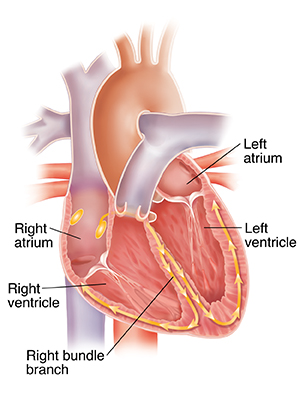
What causes right bundle branch block?
Right bundle branch block can be caused by a number of conditions, such as:
-
Heart disease from high blood pressure.
-
Chronic obstructive lung disease.
-
Blood clot in the lung (pulmonary embolism).
-
Cardiomyopathy.
-
Myocarditis.
-
Heart attack.
-
Congenital heart disease.
-
Surgery or other procedures on the heart.
In some cases, the cause of right bundle branch block isn't known. The heart otherwise looks normal.
What are the symptoms of right bundle branch block?
Right bundle branch block doesn't usually cause symptoms in itself. It may make symptoms of other heart problems worse, such as heart failure.
How is right bundle branch block diagnosed?
Right bundle branch block is diagnosed with an electrocardiogram (ECG). This test looks at the heart’s rhythm. The condition is often found during an ECG for some other reason. Your doctor may want to check you for other health problems. They may ask about your health history, any symptoms you may have, and give you a physical exam. You may also have other tests, such as:
-
Echocardiogram to create moving pictures of your heart to determine how well your heart is pumping blood.
-
Testing to check the health and function of your lungs.
-
Blood tests to look at your overall health.
How is right bundle branch block treated?
If you have no symptoms and no other underlying heart conditions, you usually don't need treatment. If you have heart disease, your doctor will want to keep track of your heart health. In some cases of severe heart failure, or other conduction disease, you may need a pacemaker. It can help restore a normal heartbeat.
Living with right bundle branch block
Your doctor may give you more instructions about how to manage your overall heart health. You might need to make lifestyle changes, such as:
-
Losing weight.
-
Quitting smoking.
-
Improving your diet.
Keep track of any heart symptoms you have. See your doctor regularly, even if you don’t have any symptoms. Make sure all your doctors know about your right bundle branch block.
When to contact your doctor
Contact your doctor or get medical care right away if:
-
You have new lightheadedness or dizziness.
Call 911
Call 911 if:
-
You have chest pain.
-
You faint.
-
You are short of breath.

Related Articles
Understanding First-Degree Heart Block
First-degree heart block is a condition where the wiring of the heart is slow to send electrical signals for the heartbeat. Learn about its causes, symptoms, and treatment.
Sudden Cardiac Arrest
When the heart suddenly stops beating, it is called sudden cardiac arrest. Emergency treatment is needed to get the heart beating again. If treatment is not started right away, sudden cardiac arrest can lead to death.
Sick Sinus Syndrome
Sick sinus syndrome (SSS) is a type of abnormal heartbeat, or arrhythmia. If you have SSS, you may have episodes when your heart beats very slowly, stops beating for a short while, or beats very rapidly.
Understanding Atrial Flutter
Atrial flutter is a type of arrhythmia. It causes the heart to beat faster than normal. Atrial flutter can increase the risk for certain serious problems, such as stroke.