Treatment

Cataract Treatment: Removing the Cloudy Lens

Choose a preferred language

A cataract is a clouding of the lens in your eye. Surgery can be done to remove the cataract and replace the lens. This can help you see better. The two most common ways to remove a cataract are phacoemulsification and extracapsular extraction.


Phacoemulsification

A small cut (incision) is made in the cornea. This is the clear cover on the front of your eye. Or a cut may be made in the white part of your eye (sclera). Then an opening is made in the anterior capsule. This is the front portion of the thin outer covering of the lens. A tiny ultrasound probe is inserted into the lens through the opening in the anterior capsule. Sound vibrations from the probe break the cloudy lens into tiny pieces. The pieces are then suctioned out. Stitches may be needed after this is done.
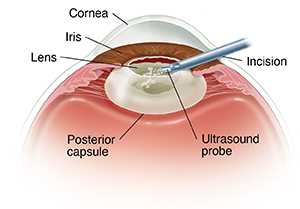
Front view cross section of eye showing instrument removing lens.


Extracapsular extraction

This method makes a larger cut in the cornea. The entire lens can then be removed at once through the cut. Stitches are used to close the cut after the procedure.
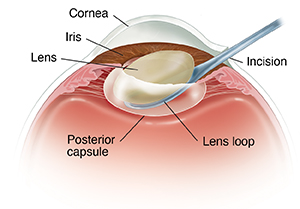
Front view cross section of eye showing instrument removing lens.


Implanting an IOL

After the cloudy lens is removed, it's replaced with a plastic lens called an IOL (intraocular lens). 

© 2000-2026 The StayWell Company, LLC. All rights reserved. This information is not intended as a substitute for professional medical care. Always follow your healthcare professional's instructions.
Related Articles
Read article
Eye Care
Trabeculectomy

Trabeculectomy is a type of surgery done in the front part of your eye to treat glaucoma. It lowers the pressure in your eye.

Read article
Eye Care
Having Pneumatic Retinopexy

Pneumatic retinopexy is a procedure to correct a detached retina. It helps to bring back vision. It uses a special tool to fix the retina and a small bubble of gas to hold the retina in place so it can heal.

Read article
Eye Care
Having a Trabeculectomy

Trabeculectomy is a type of eye surgery done in the front part of the eye. It’s done to treat glaucoma by draining some fluid from the eye. If you have glaucoma, fluid can drain too slowly. This can cause the pressure in your eye to increase. More pressure is then placed on the optic nerve. This surgery helps to lower pressure inside the eye.

Read article
Eye Care
Understanding Laser Photocoagulation for Age-Related Macular Degeneration (AMD)

Laser photocoagulation uses a laser to seal off abnormal blood vessels in your eye. Laser photocoagulation can't restore eyesight that you already have lost. But it may slow down the damage to your central vision.