Definition

How You Hear

Choose a preferred language

Sound moves through the air like the ripples you see after throwing a stone into a pond. Your ears collect these waves of sound around you and send them to your brain. This is how the parts of your ear work so you can hear.


Three parts of your ear

Your ear is made up of the following parts: 

  • Your outer ear collects sound waves.

  • Sound waves enter the ear and hit the eardrum in your middle ear. Three tiny bones in the middle ear are set into motion.

  • This transfers sound waves to the fluid-filled inner ear. There, thousands of hair cells turn sound waves into nerve impulses. These impulses travel along nerves to your brain. When the impulses reach your brain, you perceive sound.
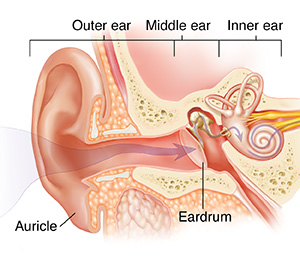
Cross section of ear showing outer, inner, and middle ear structures.


Damaged hair cells affect hearing

Hair cells move when incoming sound vibrates the inner ear fluid. The motion is turned into impulses that let you hear the sound.

Loud noise causes hair cells to move too much and can damage them. Flattened hair cells can't fully send nerve impulses to your brain. Once damaged, hair cells never recover.
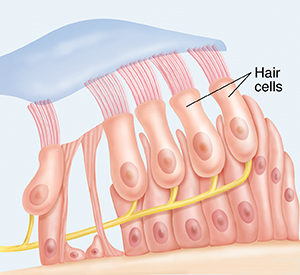
Hair cells in the cochlea.

© 2000-2026 The StayWell Company, LLC. All rights reserved. This information is not intended as a substitute for professional medical care. Always follow your healthcare professional's instructions.
Related Articles
Read article
Ear, Nose, and Throat
Understanding Nasal Anatomy: Outside View

Why does your nose look the way it does? And what goes on inside a nose to let a person breathe easily? Learning the anatomy of the nose can help you better understand the answers to these questions.

Read article
Ear, Nose, and Throat
Vocal Cord Disorders

Vocal cord disorders can affect your voice or your ability to talk. They are often caused by using the voice too much when singing, talking, coughing, or yelling.

Read article
Ear, Nose, and Throat
Tinnitus (Ringing in the Ears)

Tinnitus is the term for a noise in your ear not caused by an outside sound. It is also called ringing in the ears. Learn about some of the treatments that may help this condition.

Read article
Ear, Nose, and Throat
What Is Ménière Disease?

Ménière’s disease is a problem with the inner ear. This part of the ear is responsible for balance as well as hearing. This sheet will tell you more about the disease and its symptoms.